Why Your Belly Fat Won't Move: Understanding Insulin Resistance, Prediabetes, and Type 2 Diabetes
Apr 16, 2026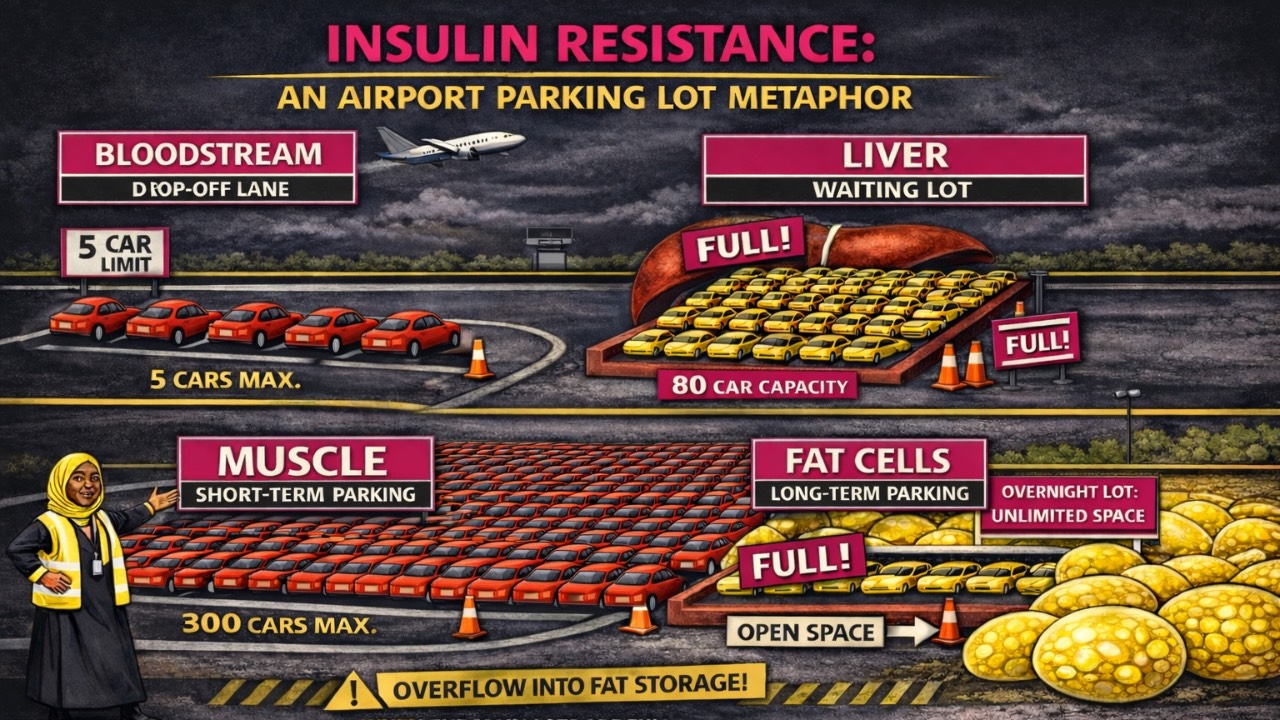
You are doing everything right.
You cut the sugar. You walk. You fast Ramadan faithfully. You swapped the white rice for brown. You said no to the dessert table at every gathering while everyone else helped themselves twice.
And the belly fat is still there. The energy is still gone. The scale has not moved in two years.
You are not broken. You are not lazy. You are not being punished.
Your body is gridlocked. And nobody explained why.
Once you understand what I am about to show you, you will never look at belly fat, energy crashes, blood sugar, or weight loss the same way again. More importantly, you will finally understand why everything you have tried has not worked — and what actually will.
The Science Behind the Traffic Jam
Let's get into the biology first, because you are a high-achieving woman and you deserve the real explanation — not a pamphlet.
Every time you eat, your body launches a precise, elegant operation designed to keep you energized, clear-headed, and functioning at full capacity. Here is how it works.
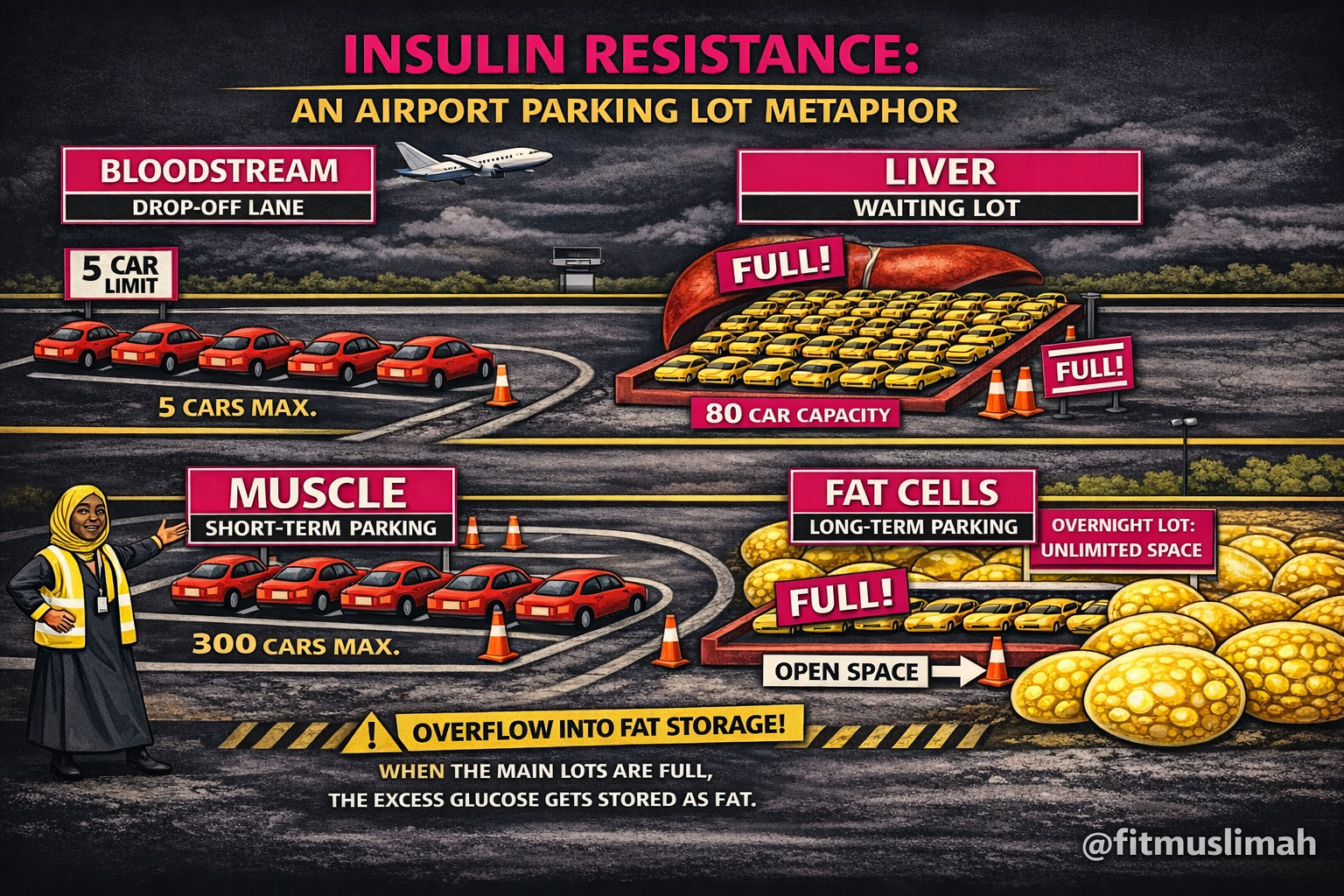
Insulin is your parking attendant. His job is to direct incoming traffic — glucose — and keep everything moving smoothly through the system.
Glucose is the incoming traffic. Every time you eat carbohydrates — bread, rice, fruit, pasta, honey, dates, anything the body converts to sugar — cars start pulling into the lot. The more carbohydrates you eat, the more cars arrive at once.
Your bloodstream is the drop-off lane. And here is the detail nobody tells you: the drop-off lane was never built to hold much traffic. At any given moment, your bloodstream holds only about five cars worth of glucose. Five. The rest has to go somewhere else immediately.
When the system is working the way Allah designed it, insulin moves glucose out of the bloodstream quickly and efficiently. Into storage. Into energy. Clean. Smooth.
But here is what happens when the lots start filling up:
- The liver fills first. Think of it as the waiting lot — it holds about 80 cars worth of glucose stored as glycogen. When you need quick energy between meals, the liver releases some back into the bloodstream. Smart and efficient, when it is not overloaded.
- The muscles fill next. Muscle tissue is your short-term parking lot. For the average woman over forty, especially one who is not doing resistance training, the muscle lot holds about 300 cars worth of glucose. This is why strength training is the most powerful tool for blood sugar control — more muscle means more parking space and less overflow.
- The fat cells absorb the rest. When the liver is full and the muscles are full, insulin has one option left. Long-term storage. Your fat cells. And unlike the liver and muscles, long-term parking has virtually unlimited capacity.
This is where the belly fat comes from. Not from laziness. Not from lack of willpower. From a specific, physiological process in which your body is doing exactly what it was designed to do — storing overflow energy — but the overflow never stops coming.
That is insulin resistance.
The parking attendant is still showing up to work. He is still directing traffic. But the main lots are crowded, the drop-off lane is backing up, and now it takes more and more insulin just to manage the same amount of incoming glucose.
The Three Stages Nobody Warned You About
Insulin resistance does not announce itself. It builds quietly over years while your labs look normal and your doctor tells you everything is fine. But your body has been sending signals the whole time.
Stage One: Insulin Resistance
The lots are getting full. Your pancreas is producing more insulin than it used to just to move the same amount of glucose. Your labs might still look normal. But the system is already under pressure.
Signs you might be here:
- Belly fat that appeared after forty and will not move no matter what you eat
- Energy that crashes after every meal and never fully comes back
- Cravings for sugar and carbohydrates that feel biological, not psychological
- Consistency that keeps breaking down not because you are weak but because your hormones are working against every effort you make
- Perimenopausal symptoms that feel more intense than they should — because insulin resistance and hormonal chaos feed each other directly
Stage Two: Prediabetes
Now the drop-off lane is backing up. Your fasting glucose is creeping upward. Your doctor may have mentioned borderline numbers and told you to watch your diet.
What they likely did not tell you is that prediabetes is your last real exit ramp before the highway gets significantly worse. It is the point at which the right intervention can still reverse the progression entirely.
Signs you might be here:
- Elevated fasting glucose on your labs
- Fatigue that sleep does not fix
- Brain fog affecting your focus at work and your khushoo in salah
- Belly fat specifically concentrated around your midsection — visceral fat, the most metabolically dangerous kind
- Consistency that collapses under any stress because your cortisol and insulin are both dysregulated
For women navigating perimenopause, this stage is particularly critical. As estrogen drops, your cells become less responsive to insulin. As cortisol rises from chronic stress, more glucose floods the drop-off lane. As muscle mass decreases with age and inactivity, your short-term parking lot shrinks. The system that was already under pressure gets hit from every direction at once.
Perimenopause does not cause insulin resistance. But it is gasoline on a fire that was already burning.
Stage Three: Type 2 Diabetes
The traffic is no longer under control.
The parking attendant has been working overtime for so long that the pancreas starts to wear out. Insulin production drops. Now you have two simultaneous problems: too much glucose flooding the system and not enough insulin to direct it.
The cars are not just crowding the lots anymore. They are on the sidewalks. Blocking the entrances. Jamming the roads. Spilling into places they were never meant to be — your blood vessels, your nerves, your kidneys, your eyes.
And here is the cruelest part of type 2 diabetes that most people do not understand: even though glucose is everywhere in your bloodstream, your cells are starving for energy. The delivery system has broken down. Your brain is foggy. Your body is exhausted. Your organs are working inside a system that is completely gridlocked.
The long-term consequences extend far beyond the scale. Nerve damage. Cardiovascular disease. Vision loss. Reduced mobility. The inability to fast during Ramadan. The inability to make full sujud at seventy because the body that was meant to worship with strength and vigor has been running on empty for decades.
The Spiritual Weight of a Gridlocked Body
Here is what your doctor will not tell you — and what I believe with everything in me.
Your physical health and your spiritual life are not separate conversations. They are the same conversation.
Allah SWT says in the Quran: "And do not throw yourselves into destruction" (2:195). The scholars of tafsir have long understood this ayah to include the neglect of our own health. Your body is an amanah — a trust from Allah. You did not create it. You do not own it. You are its caretaker.
When insulin resistance goes unaddressed, it does not just affect your waistline. It affects your ability to stand in salah without exhaustion. It affects your focus during Quran recitation when brain fog clouds every thought. It affects your patience as a mother and a wife when your blood sugar is crashing and your cortisol is spiking. It affects your capacity to serve your community, your family, and your deen with the energy and clarity that service requires.
The Prophet Muhammad ﷺ said: "The strong believer is better and more beloved to Allah than the weak believer, although there is good in both." (Muslim)
Strength here is not vanity. It is not fitting into a smaller size or reaching a number on the scale. It is the functional, metabolic strength that lets you make full sujud at seventy. That lets you fast Ramadan with clarity instead of crashing by Dhuhr. That lets you be fully present for your ibadah instead of fighting your own biology just to get through the day.
When you address insulin resistance, you are not just losing weight. You are reclaiming the vessel Allah gave you for worship.
The Fix Is Not Fewer Cars. It Is a Better System.
Here is the insight that changes everything.
Every diet you have ever tried was focused on reducing the number of cars. Fewer calories. Fewer carbohydrates. Less food overall. And while reducing glucose intake matters, it addresses only one part of a much larger problem.
The real fix requires three things working together:
Expand the parking lots. Strength training builds muscle tissue — your largest glucose storage site. More muscle means more short-term parking space, which means less overflow to fat storage. This is why resistance training reverses insulin resistance more effectively than any other form of exercise.
Reduce the incoming traffic strategically. Not all carbohydrates affect insulin the same way. An insulin-centered nutrition approach identifies which foods flood the drop-off lane and which foods support steady, manageable traffic flow. This is not about eating less. It is about eating in a way that works with your metabolic biology. And yes — rice turns into sugar. Bread turns into sugar. The icing and the cake are both the problem.
Retrain the parking attendant. Insulin sensitivity — the ability of your cells to respond efficiently to insulin — can be restored. Through the right combination of nutrition, strength training, stress management, and sleep optimization, the parking attendant can go from exhausted and overwhelmed to efficient and effective.
This is what reversing insulin resistance actually means. Not a temporary fix. Not a crash diet that clears the lane for six weeks before the traffic backs up again. A structural change to the system itself.
You Are Not Too Far Gone
I want to say this clearly, because too many women have been told otherwise.
Every stage of this progression is addressable. Every single one.
I have worked with women who came to me with A1C levels that made their doctors shake their heads — and within months those same doctors were taking them off medication. I have worked with women who had not been able to fast Ramadan in twenty years and fasted again after going through the program. I have worked with women who were told this was just their life now and discovered that it absolutely did not have to be.
The body wants to heal. It was designed to heal. Allah created your metabolism with extraordinary resilience. But it cannot heal in the same environment that broke it.
You cannot clear a traffic jam by adding more cars.
You cannot fix insulin resistance with the same tools that caused it. You cannot reverse prediabetes with a pamphlet and a walking challenge. You cannot manage type 2 diabetes long-term with medication alone while the root cause goes unaddressed.
You have to change the system.
The Bottom Line
Insulin resistance, prediabetes, and type 2 diabetes are not three separate conditions. They are three stages of the same progression. A parking lot that started getting busy, then got crowded, then reached complete gridlock.
And the women most at risk are not the ones who are lazy or undisciplined. They are the high-achieving, faith-driven women in their forties and fifties who have been handed the wrong tools for too long. Who have been told to eat less and move more while their hormones, their stress levels, and their metabolic biology were working against every effort they made.
Your body is an amanah from Allah. It was designed for strength, longevity, and worship performed with vigor.
The traffic can clear. The lots can be rebuilt. The parking attendant can work efficiently again.
But it will not happen on its own. And it will not happen with the same tools that have been failing you.
Understanding the parking lot is the first step. What you do with that understanding is the next one.
LIKE, SAVE, SHARE
Get delicious recipes that will help you break your sugar addiction, balance your hormones and finally lose the weight right in your email.
